
Hip cup
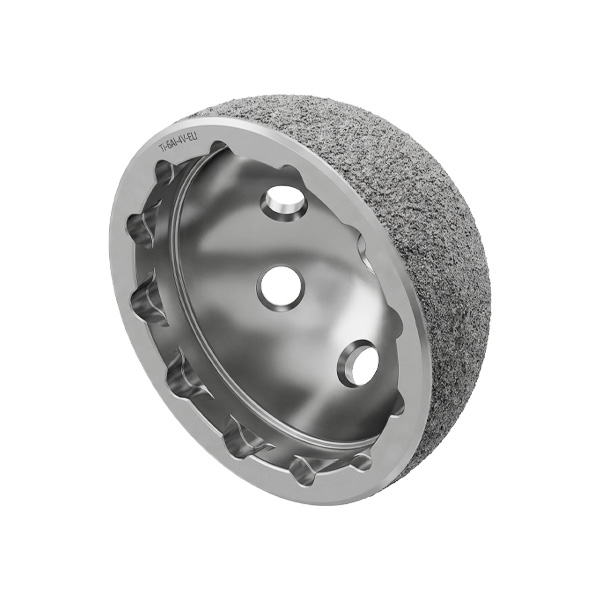
Mastering High-Precision Acetabular Cup Machining
In the realm of orthopaedic implant production, the fabrication of the acetabular cup is widely considered a pinnacle of machining difficulty. Achieving a flawless hemispherical geometry requires more than just standard turning and milling; it demands absolute mastery over cutting dynamics to ensure ultra-smooth bearing surfaces and micron-level tolerances.
Whether your facility is processing traditional Cobalt-Chromium (CoCr), medical-grade Titanium or complex 3D-printed preforms, the challenge remains the same: managing material hardness and density variations while maintaining process stability.
The Anatomy of Total Hip Replacement (THR)
A successful THR is a symphony of interconnected parts. Each component must meet rigorous standards to ensure the implant’s longevity and the patient’s mobility:
- Femoral Stems: The structural anchor requiring high-fatigue resistance.
- Modular Morse Tapers: The critical friction-fit connection between the stem and the head.
- Ball Heads: Spherical components requiring mirror-like finishes.
- Acetabular Cups: The outer socket that facilitates joint articulation.
- Liner: the bowl-shaped polyethylene component that acts as the new socket surface for the femoral head.
Small deviations in the internal spherical mating surface or in the Morse taper can lead to catastrophic wear or implant loosening. Our micro-machining portfolio is designed to suppress vibration and manage thermal input, ensuring every functional surface - from dovetail geometries to locking interfaces - is perfectly executed.
The Optimized Acetabular Cup Machining Workflow
1. Structural Material Removal (Roughing)
The journey begins with forged billets or additively manufactured blanks. Roughing operations are tasked with aggressive material removal to establish the primary spherical shape.
- The Challenge: Interrupted cuts on 3D-printed "skin" and varying hardness in CoCr castings.
- The Solution: Tooling with reinforced cutting edges and high-thermal-stability coatings that provide predictable wear even under heavy loads.
2. Geometry Stabilization (Semi-Finishing)
Semi-finishing acts as the bridge to precision. The goal here is to refine the form and ensure a uniform finishing allowance for the final pass.
- Focus: Accurate internal hemisphere shaping and establishing stabilized surface patterns.
- Outcome: Improved chip flow and reduced thermal distortion, creating a repeatable baseline for large-scale production batches.
3. Surface Definition (Acetabular Cup Finishing)
As the final and most critical phase, acetabular cup finishing dictates the wear characteristics of the entire joint. The surface must reach specific roughness standards.
- Micro-Finishing Capabilities: Our tools enable ultra-low cutting pressure and controlled radial engagement.
- Clinical Impact: This phase eliminates micro-fractures and chatter marks, resulting in an orthopaedic-grade surface that minimizes long-term joint friction.
Interface Integrity: Beyond the Cup
Precision Morse Taper Machining
The modularity of modern hip implants relies on the Morse taper. Machining these internal and external tapers requires exact angular and specific profile surface conformity to prevent fretting corrosion.
- Tooling Advantage: Our profile milling solutions ensure stable torque transmission and a high-integrity fit between the stem and the femoral head, which is highly important for modular stability.
Hip Ball Polishing Preparation
Before the femoral head reaches its final mirror finish, it must undergo meticulous preparation.
- Surface Preconditioning: Our cutting solutions provide uniform stock removal on CoCr balls, significantly reducing the time required for downstream hip ball polishing while maintaining spherical truth.
Scaling Your Orthopaedic Production
Modern THR manufacturing requires more than just a sharp tool; it requires a validated process. Our high-precision portfolio offers:
- Thermal Management: Vital for maintaining tolerances in multi-axis environments.
- Cycle Time Optimization: Faster throughput without compromising sub-micron accuracy.
- Traceability: Consistent results that meet stringent regulatory and automated inspection standards.
Do you need any advice from us? Contact us here!