
Joints
High-Performance Machining Strategies for Orthopaedic Joint Prosthetics
Fabricating medical-grade joint replacements requires a synergy of extreme dimensional accuracy and biological safety. Producers of hip, knee, shoulder and other systems face the dual challenge of navigating difficult-to-cut materials like Cobalt Chromium (CoCr) and Titanium alloys while adhering to micro tolerances.
Our specialized machining portfolio provides a comprehensive solution across the orthopaedic workflow - bridging the gap between initial roughing and high-fidelity finishing.
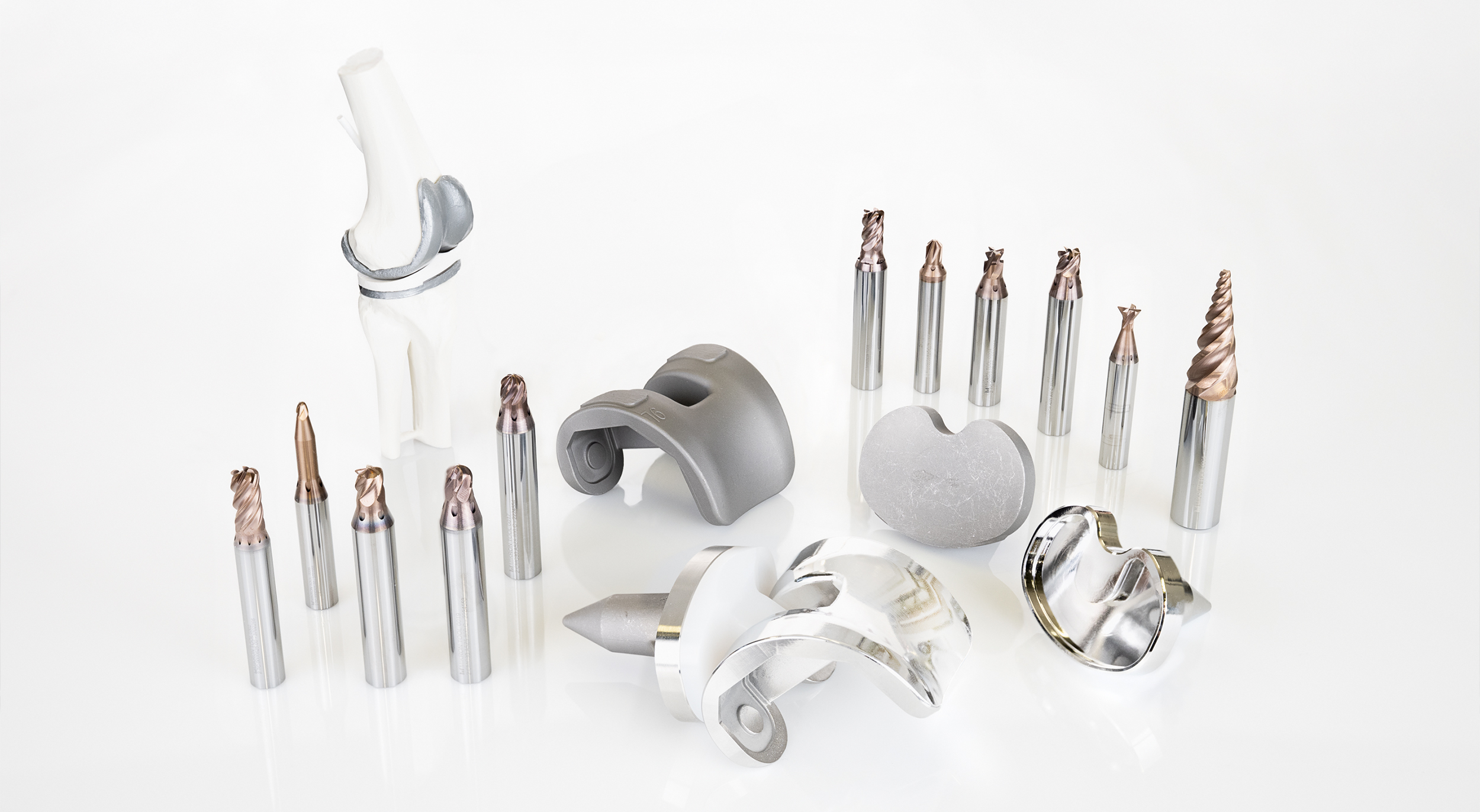
Material & Process Optimization Table
| Feature | Material | Key Machining Challenge | Machining Requirement |
|---|---|---|---|
| Femoral Components | CoCr / Cast | Thermal & Mechanical load management | Surface finish Ra 0.3 µm |
| Tibial Trays | Titanium / CoCr | Intricate locking features | Burr-free dovetail milling |
| Femoral Stems | Titanium / CoCr | Tool deflection/vibration | Precise Morse taper & surface angularity |
| Acetabular Cups | Titanium / CoCr | Burrs | Burr-free transitions and profile accuracy |
Advanced Knee Replacement Manufacturing
High-Precision Femoral Component Milling
The complex, organic geometry of the femoral component requires sophisticated tool path engagement. Because CoCr is notoriously abrasive, our cutting tools are engineered with specialized edge preparations to mitigate heat and tool wear.
- Surface Integrity: Achieving a surface roughness of Ra 0.3 µm is required for or avoiding post-treatment processes.
- Thermal Control: Our geometries minimize heat generation, preserving the material's biocompatibility.
- Additive Support: Our tooling platforms are equally effective for finishing 3D-printed near-net-shape components.
Tibial Tray & Baseplate Engineering
Tibial components require a mix of high-speed pocketing and intricate detail work. The focus here is on dimensional flatness, surface quality (Ra ≤0.2 µm) and the execution of retention features.
- Locking Mechanisms: Specialized micro-cutters for high-accuracy dovetail milling and undercut generation.
- Chip Evacuation: Optimized flute designs prevent chip re-cutting in deep pockets, a common cause of tool failure when machining difficult-to-machine materials, such as Titanium or CoCr alloys.
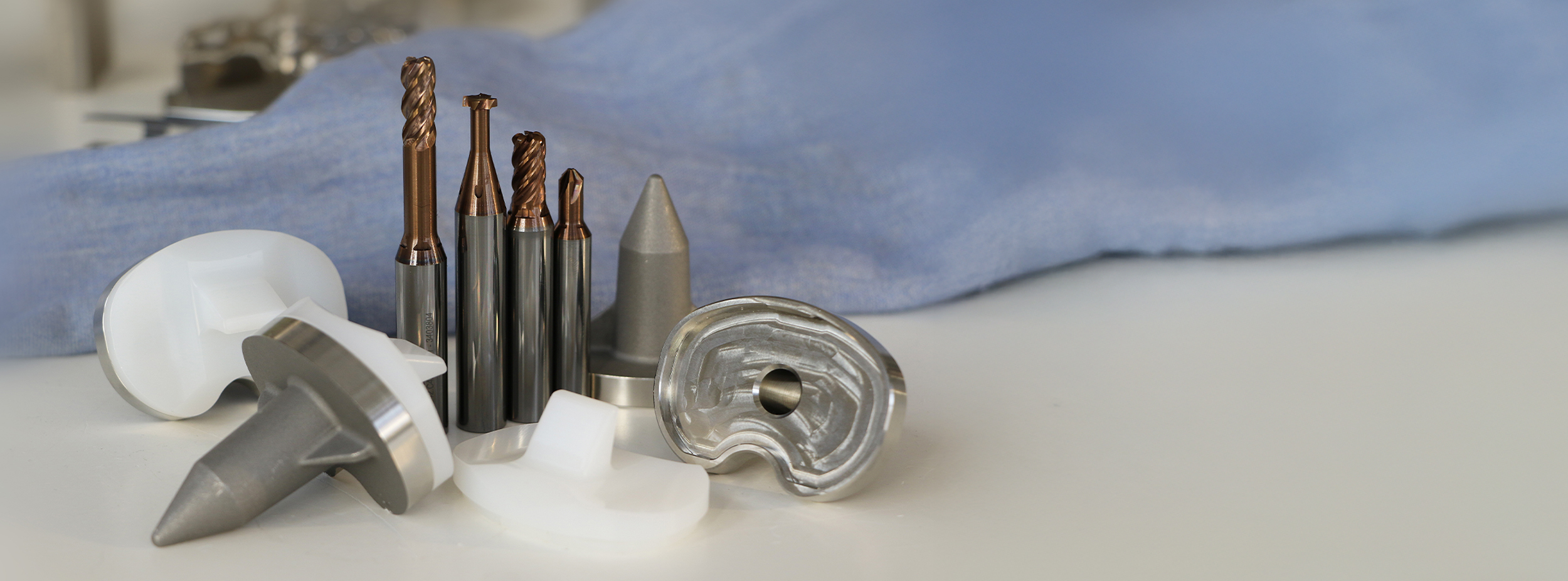
Hip Replacement Component Solutions
Morse Taper & Femoral Stem Accuracy
The interface between the femoral stem and the head (the Morse taper) is critical for the mechanical stability of the implant. Even a slight angular deviation can lead to fretting or loosening.
- Deflection Management: For long, slender femoral stems, our endmills utilize specific geometries to reduce radial cutting pressure.
- Consistency: Maintain micro-level accuracy across entire production batches to ensure universal fitment.
Acetabular Cup Locking Hole
The acetabular cup demands perfect fixation. Mikron Tool’s unique set of tools and strategies ensure a burr-free process and perfect profile accuracy, to ensure proper, secure fit and avoid damage.
Shoulder Implant & RSA Innovation
Reverse Shoulder Prosthesis (RSA) Machining
The rise in Reverse Shoulder Arthroplasty (RSA) has introduced new complexities, specifically small-diameter features and deep, confined cavities.
- Glenoid Component Milling: We provide micro-tools designed for stability in angled fixation pockets, ensuring the implant seats perfectly against the scapula.
- Humeral Stem Production: Much like hip stems but at a smaller scale, these require tools capable of high-reach stability and smooth chip evacuation for a reliable manufacturing process.
Why Partner with Our Machining Experts?
As regulatory requirements for medical devices tighten, "good enough" is no longer an option. Our cutting technologies empower manufacturers to:
- Maximize Tool Longevity: Reduced tool changes during the finishing of abrasive CoCr alloys.
- Accelerate Cycle Times: High-efficiency endmills and milling strategies that don't sacrifice surface quality.
- Scale with Confidence: Transition from R&D prototypes to high-volume mass production without losing process security.
Technical Note: Process reliability is the foundation of orthopaedic manufacturing. By stabilizing cutting forces, we reduce the risk of rework and ensure that every implant meets rigorous clinical standards.
Do you need any advice from us? Contact us here!